What Is a Hollywood Smile?
One of the most well-known yet most frequently misunderstood concepts in aesthetic dentistry is the “Hollywood Smile” (Smile Design). The common perception is that this treatment involves applying identical, overly white, factory-made teeth to every patient. However, within our institutional medical approach, a Hollywood Smile is the process of designing and creating the most natural and organic smile specifically tailored to the individual through a detailed analysis of the patient’s facial features, expressions, lip structure, and even personality.
Based on the clinical experience we have gained since 2003, our unwavering philosophy is that aesthetics should represent not “artificiality,” but “perfect naturalness.” A true smile design is a medical work of art that never appears “done” from the outside, but instead looks like an organic and harmonious part of the patient’s own face.
From Standard Whiteness to “Personalized” Facial Harmony
Every individual’s facial anatomy is as unique as a fingerprint. For this reason, a successful smile design cannot be achieved by focusing solely on the shape of the teeth. At our clinic, diagnostic protocols begin with analyzing the imaginary facial midline, the horizontal line passing through the pupils (pupillary line), and the curvature of the lips during smiling.
Through this holistic approach, known in medicine as “Facial Harmony,” patients with sharper facial features may be designed with softer, more oval tooth forms to create a balanced and gentle appearance, while patients with rounder facial features may benefit from more defined and angular tooth forms to achieve a stronger, more characteristic expression. Even the shade of the teeth is carefully selected according to the patient’s skin undertone and eye color.
The Foundation of Smile Architecture: The Golden Ratio (Phi Principle)
The “Golden Ratio,” considered the mathematical representation of perfection in nature, forms the fundamental engineering principle behind the Hollywood Smile designs performed at our clinic. During a smile, the proportion between the two central front teeth (centrals), the adjacent lateral teeth (laterals), and the canine teeth (canines) must follow a specific mathematical relationship. Only when this proportion is achieved does the human eye perceive the smile as aesthetic and attractive.
However, while applying these mathematical principles, the patient’s age and gender are also carefully considered. For example, designing the two front teeth slightly longer in female patients adds a sense of youthfulness, femininity, and dynamism to the face, whereas flatter and more even contours in male patients create a stronger and more authoritative appearance.
Integration of Pink Aesthetics (Gums) and White Aesthetics
One of the most critical factors—often overlooked even in the informational content of major healthcare institutions—yet responsible for nearly 50% of the success of a Hollywood Smile, is “Pink Aesthetics,” meaning gum health. No matter how flawless and proportionate the teeth (white aesthetics) may be, if the gums appear asymmetrical, excessively visible during smiling (gummy smile), or inflamed in color, the smile cannot be considered truly aesthetic.
Before beginning the smile design process, the gum structure is precisely reshaped with laser technologies to achieve symmetry and a healthy foundation. The perfect tissue harmony established at the junction between the teeth and gums ensures that porcelain or zirconia restorations remain healthy and stable for many years without causing gum recession.
Functional Integrity and Chewing Harmony (Occlusal Balance)
One of the greatest medical mistakes made during smile design planning is focusing solely on the visible “showcase” aspect of the teeth while forgetting that the mouth is a dynamic system that functions thousands of times each day. An aesthetic restoration must also serve as a fully functional structure.
The Hollywood Smile process is designed by taking into account the relationship between the upper and lower jaws, the movement pathways of the temporomandibular joint (TMJ), and occlusal balance (chewing harmony). Procedures performed solely with aesthetic concerns, without evaluating functional balance, may lead over time to fractured restorations, chronic jaw joint pain, or muscle spasms in the neck area.
For this reason, every smile designed in our clinic is planned as a complete integration of both aesthetics and chewing functionality.
Digital Smile Design: 3D Planning and Mock-Up (Preview) Protocol
One of the greatest disadvantages of traditional methods in aesthetic dentistry was that patients could never fully predict the final outcome until the treatment was completed. Today, within our institutional polyclinic standards, this “guess-based” approach has been completely abandoned.
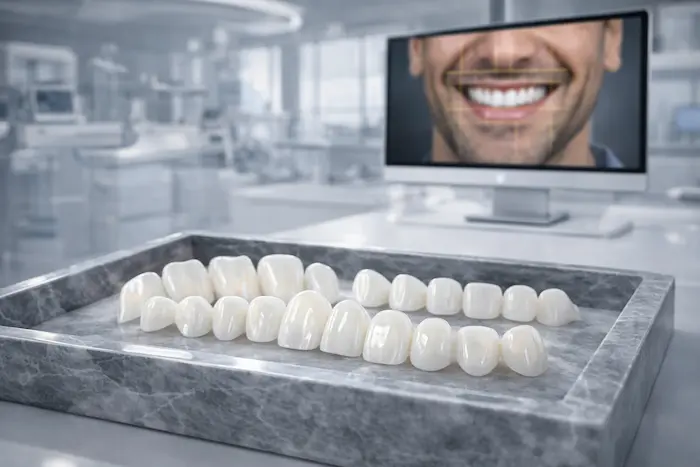
In Hollywood Smile (Smile Design) treatment, success does not begin in the dental chair, but during the digital laboratory and planning phase. Thanks to computer-aided digital dentistry (CAD/CAM) technologies, we are able to construct the patient’s final smile with millimetric precision in a virtual environment before making any physical intervention on the natural tooth structure.
This technological transparency completely eliminates the patient’s concern of “Will my new smile suit my face?” and establishes the entire medical process on a foundation of trust and confidence.
Precise Impression Taking with Digital Intraoral Scanners
The first and most important step of smile design is the precise digital transfer of your existing teeth, gum structure, and jaw anatomy into a computer environment. Traditional impression materials, which often caused discomfort and gag reflexes in patients, are no longer used within our advanced clinical workflow.
Instead, digital intraoral scanners equipped with high-precision optical cameras are used to create a three-dimensional topographic map of your teeth. During the procedure, no physical pressure or discomfort is felt. Within seconds, a high-resolution virtual model is generated, containing data with micron-level precision.
This technology ensures that future porcelain or zirconia restorations fit perfectly without gaps, significantly minimizing the risk of microleakage and secondary decay.
Dynamic Facial Analysis and Computer-Aided Design (CAD)
Smile design cannot be created solely based on a static X-ray or dental impression. The human face is a dynamic structure that is constantly in motion while speaking, smiling, and expressing emotions. For this reason, in addition to digital intraoral scans, high-resolution photographs and video recordings are taken from multiple angles in a professional setting at our clinic.
These visual data are transferred into specialized aesthetic design software, where the digital dental model is precisely matched with the patient’s facial structure. The movement of the lip muscles, the visibility of the teeth during speech (especially while pronouncing sounds such as “F” and “V”), and the curvature formed by the lower lip during smiling are medically analyzed through these software systems.
The form of the new teeth is then designed entirely from scratch and fully personalized according to the data obtained from this dynamic facial analysis.
Mock-Up (Preview) Application: Experiencing the Final Result Before Treatment Begins
The most valuable stage of the digitally prepared smile design for patients is the Mock-Up (Preview) protocol. The perfectly designed smile, created with millimetric precision in the digital environment, is transformed into a physical model in the laboratory using 3D printing technology.
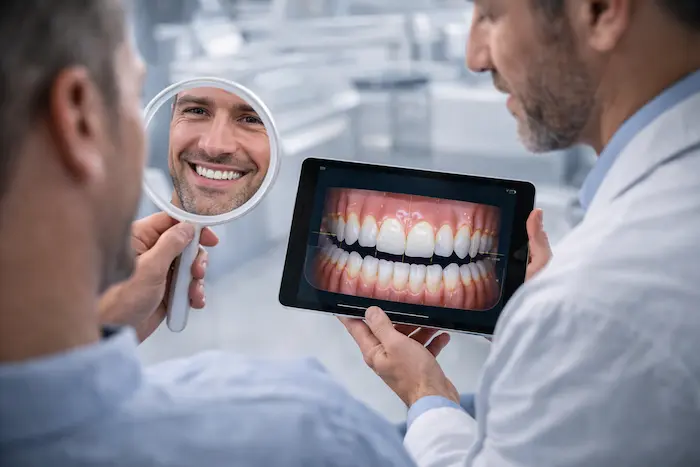
This design is then transferred directly onto your natural teeth using a special reversible temporary material—without any drilling, tooth reduction, or anesthesia. In other words, before the treatment even begins, you are able to see the final result live in the mirror, on your own face.
During this preview session, you and your dentist can evaluate the length, shape, and lip harmony of the teeth together, and any desired modifications (for example, “I would like the tooth edges to appear slightly more rounded”) can be adjusted immediately in the clinic.
The Mock-Up protocol is our greatest medical assurance in eliminating uncertainty and unexpected outcomes.
Reconstruction of Lip Support and Rejuvenation Effect
Over the years, teeth that become worn due to chewing, experience enamel loss, or shorten in length not only compromise smile aesthetics, but also lose the strong biomechanical support they provide to the lips from within. As the vertical dimension of the teeth decreases, the lips begin to collapse inward, and aging lines around the mouth (nasolabial folds) gradually become more pronounced.
During the digital planning phase, this lost dental volume is carefully recalculated and restored. The newly designed tooth forms provide renewed internal support to the lips, creating a natural fullness and a non-surgical anti-aging effect on the face.
As a result, the Hollywood Smile treatment we provide goes far beyond simple tooth whitening, evolving into a comprehensive approach that anatomically restores and rejuvenates the lower facial profile.
Step-by-Step Hollywood Smile: Clinical Treatment Process and Session Protocols
After the digital planning phase (Mock-Up) and material selection are completed in aesthetic dentistry, the clinical treatment stage begins. Within our institutional polyclinic workflow, Hollywood Smile (Smile Design) treatment is not an uncertain process that leaves patients exhausted in the dental chair for hours; rather, it is a highly comfortable and systematic medical protocol with every step planned with millimetric precision in advance.
Although the duration may vary depending on the existing oral condition of the patient and the selected material (Laminate Veneers or Zirconia), the entire transformation process is generally completed within 3 to 7 days through an average of 3 main sessions.
Throughout this process, our primary principle is to ensure that patients can continue their social lives without interruption while preserving tissue health at the highest level through minimally invasive treatment protocols.
Tooth Surface Preparation and Temporary Restorations (Tissue-Preserving Approach)
The first clinical session, where the treatment physically begins, involves preparing the tooth surfaces for the porcelain restorations. Since the entire procedure is performed under highly effective local anesthesia, patients experience absolutely no pain or discomfort. In line with our preventive and minimally invasive treatment philosophy, the integrity of the natural teeth is preserved.
If the selected treatment is Laminate Veneers, only the front surface of the tooth is gently prepared with an ultra-precise reduction of approximately 0.3–0.5 millimeters—roughly the thickness of a contact lens.
Immediately after the preparation process is completed, a three-dimensional digital impression of the teeth is taken using advanced intraoral scanners. One of the greatest advantages of this session for our patients is that they never leave the clinic “without teeth” or with an unaesthetic appearance. As soon as the digital impressions are sent to the laboratory, temporary fixed restorations matching the patient’s natural tooth shade are applied.
These temporary teeth not only preserve aesthetics until the final restorations are ready, but also serve as a medical shield by protecting the prepared tooth surfaces against hot and cold sensitivity.
Laboratory Phase: Biomedical Production of Digital Art
Once the digital data obtained in the clinic reaches our integrated laboratory network, it is processed digitally through CAD/CAM systems without direct manual intervention. The newly designed tooth forms are produced by milling selected biocompatible materials—such as E-max glass ceramic or monolithic zirconia blocks—using advanced 5-axis microscopic milling devices.
However, exceptional aesthetics cannot be achieved by machines alone. After the milling process is completed, our expert technicians—often referred to as “ceramic artists”—take over the final stage. Under microscopic precision, they apply the finishing touches by creating natural enamel translucency at the tooth edges, adding organic micro-textures to the surface, and giving each restoration a lifelike character and individuality.
Biological Compatibility and Functional Evaluation Trial
Before the final restorations (Laminate Veneers or Zirconia Crowns) received from the laboratory are permanently bonded, they are carefully tested inside the mouth. This session serves as a critical final evaluation stage where both the dentist and the patient review the design in detail. The restorations are temporarily placed using special try-in gels.
At this stage, the dentist medically evaluates the harmony between the restorations and the gums (pink aesthetics), the contact relationship between the upper and lower teeth during biting (occlusal balance), and the level of lip support provided by the new teeth.
The patient then examines the harmony, color, and shape of the new smile in relation to the face while looking in the mirror. Speech (phonetic) tests are also performed to ensure the proper pronunciation of sounds such as “S,” “F,” and “V.” If either the patient or the dentist requests any refinements—for example, “the edges should appear slightly softer and more rounded”—the restorations are returned to the laboratory for final glazing adjustments.
Permanent bonding is never performed until a flawless result is achieved for all parties involved.
Medical Bonding (Permanent Integration)
After the design receives 100% approval, the treatment proceeds to the “Medical Bonding” session, during which the restorations are permanently fixed onto the teeth. The bonding procedure for Laminate Veneers or glass ceramics is far more complex than a standard crown cementation process.
Both the tooth surface and the inner surface of the porcelain restoration are treated with specialized medical solutions for cleansing and micro-etching. The advanced bonding agents used during this stage polymerize under UV light, chemically fusing the porcelain to the natural tooth enamel almost like a molecular weld.
Once this medical integration is achieved, the possibility of the restoration loosening or detaching is virtually eliminated. After the procedure is completed, the dentist performs a final millimetric occlusal balance check using articulation papers, and the Hollywood Smile treatment is successfully delivered to the patient with long-term biological stability.

Preservation of an Aesthetic Smile and Our Clinical Standards
Completing the clinical treatment sessions and achieving the flawless smile you have envisioned is, in reality, the very first day of a lifelong journey toward improved oral health. Although advanced materials used in Hollywood Smile treatments—such as E-max (glass ceramic) and Zirconia—offer exceptional resistance against fractures and discoloration, the long-term success of these restorations depends directly on the level of care maintained by the patient.
Within our institutional medical philosophy, aesthetics is not merely a procedure performed in the clinic; it is a lifelong “tissue preservation” partnership between the patient and the dentist. In order to preserve this perfect facial harmony and pink aesthetics (gum health) with the same brilliance for many years, specific medical maintenance protocols must be followed meticulously.
Long-Term Maintenance of Aesthetic Restorations and Oral Hygiene
One of the most common misconceptions among patients in aesthetic dentistry is the belief that “porcelain or zirconia teeth cannot decay, therefore they do not require maintenance.” While the materials themselves are biologically resistant to decay, the natural living tooth structure beneath them and the surrounding gum tissue remain constantly vulnerable to bacterial plaque.
If proper oral hygiene is not maintained, microleakage around the restoration margins and gum inflammation may begin to develop. Gum inflammation and recession can immediately disrupt the carefully designed smile symmetry.
For this reason, in addition to routine tooth brushing, the use of dental floss and oral irrigators is essential for cleaning the interdental areas. Gentle circular brushing movements directed from the gums toward the teeth provide the strongest medical assurance for maintaining the long-term health and stability of your restorations.
Night Guard Usage Against Bruxism (Teeth Grinding) Risk
The greatest hidden threat to a flawless smile design is bruxism—the unconscious habit of teeth grinding and clenching that most patients experience during sleep. During sleep, the human jaw can generate destructive vertical pressure nearly three times stronger than normal chewing force. Over time, this excessive pressure may cause microcracks in laminate veneers, porcelain chipping in full ceramic restorations, and traumatic stress on the roots of the natural teeth beneath the restorations.
To minimize this biomechanical risk to the highest degree, every Hollywood Smile treatment completed at our clinic is followed by the fabrication of a personalized transparent night guard, produced through digital impressions. Acting like a flexible cushion between the upper and lower jaws during sleep, these night guards absorb excessive chewing forces and provide long-term protection for your aesthetic restorations.
Hollywood Smile (Smile Design) is not merely an aesthetic transformation; it is a medical revolution in which facial harmony, chewing function, and tissue health are comprehensively reconstructed. The digital planning (Mock-Up), golden ratio analysis, and minimally invasive tissue-preserving restorations explained throughout our guide are performed with exceptional precision by our expert aesthetic dentistry team.
With the institutional healthcare vision we have maintained uncompromisingly since 2003, we provide not only bright white teeth, but a healthy, natural, and fully personalized smile that exists in complete harmony with your face.
Frequently Asked Questions
Do Porcelain Veneers or Zirconia Teeth Become Discolored Over Time?
No, they definitely do not become discolored. The Full Ceramic (E-max) and Zirconia materials used in our clinic achieve a glass-like smoothness after the final firing process known as “glazing.” Thanks to this ultra-smooth surface, staining substances such as tea, coffee, red wine, or cigarettes cannot penetrate the material.
As long as proper daily oral hygiene is maintained, your teeth will preserve their original color and brightness for many years.
Will There Be Any Pain During or After Smile Design Procedures?
You will not feel any pain during any stage of the procedures. The millimetric preparation performed on the tooth surface is carried out under highly effective local anesthesia, ensuring complete comfort throughout the treatment.
In addition, thanks to the temporary restorations placed on the same day, sensitivity to hot or cold and post-procedural discomfort are effectively prevented even after the anesthesia wears off.
How Long Does a Hollywood Smile Treatment Last?
The clinical lifespan of the restorations (Laminate Veneers or Zirconia Crowns) can range between 15 and 20 years—or even longer—depending on the patient’s oral hygiene and the control of habits such as teeth grinding or clenching.
Routine dental check-ups and professional cleanings performed at our clinic every six months will help maximize the longevity of your restorations.
Will My Speech or Pronunciation Be Affected After Smile Design Treatment?
During the Mock-Up (preview) and trial sessions performed at the beginning of the treatment, the length of the teeth, their interaction with the lips, and phonetic compatibility—especially for sounds such as “F,” “V,” and “S”—are carefully evaluated in detail.
Since the restorations are designed within natural anatomical boundaries, there is no impairment in speech or pronunciation after permanent bonding. On the contrary, because missing teeth or gaps are corrected, speech often becomes clearer, more balanced, and more aesthetically refined.
Can I Eat Apples or Hard Foods with My New Teeth?
Once laminate veneers are chemically bonded to the tooth structure, they become as durable as natural tooth enamel. You can comfortably bite into foods such as apples or sandwiches just as you would with your natural teeth.
The only recommendation is to avoid excessive or abnormal forces that could also damage natural teeth, such as cracking nuts with your teeth or opening bottle caps.